Webinars

Webinar: Software Development with OPF
This webinar will outline a set of simple steps that together provide a light, pragmatic, and consistent methodology for software development. Developers will learn how to ensure their software is used and tested as quickly as possible. Practitioners will find out how they can get help improve the quality of OPF Software projects, and influence future developments. The session WILL NOT cover techie issues such as unit testing or code comments, although it will cover continuous integration. The session WILL cover the OPF’s guidelines for use of online services such as GitHub, Travis-CI, and BinTray.

Learning Outcomes (by the end of the session attendees will be able to:)

  • Describe the OPF software projects lifecycle

  • Ensure that software is described and documented so others can find it, install it, and test it.

  • Use the Travis Continuous Integration service

  • Use GitHub to version software for release

  • Use GitHub Issues to report bugs, and suggests improvements.

Time: 12 noon BST / 13:00 CET

Duration: 1 hour

Session Lead: Carl Wilson
Date: 
29 April 2013
Event Types: 

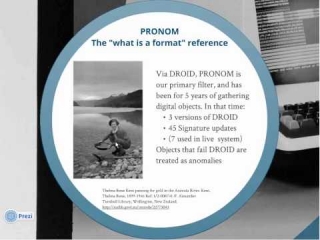
Fmt/known…? Problems with format identification at New Zealand National Library

Date: 
22 February 2013
Event Types: 

OPF Webinar: Digital Preservation at your Command – part II

31 January 2013 12 noon GMT / 13:00 CET.

In ‘Digital Preservation at your Command – Part I, attendees learned how to find content, create a checksum, identify files and create a basic manifest / profile. (The recording of this webinar can be seen here: http://openplanetsfoundation.org/opf-webinars-recordings).

This webinar will show the difference between the command line interfaces of MS-DOS, Linux and Apple. We will show how you can have tools work together and how to create a custom directory listing command which adds file format information to its output. Similar results can be achieved in MS-DOS, Linux and Apple, there is no need to install anything.

Session lead: Maurice de Rooij, National Archives of The Netherlands

This webinar will cover:

  • Comparison of command line interfaces (DOS, Linux, Apple)
  • Invoking a command line application
  • Input/output and redirection of a command line application
  • Using command line applications to create custom functionality

Who should attend?
Practitioners with basic IT skills looking to get some hands on experience of using command line tools perform some basic digital preservation tasks.

Developers who are new to Digital Preservation, or inexperienced with the use of linux command line tools.

Registration

Registration is open at: http://dp-at-your-command-ii.eventbrite.co.uk. The webinar will also be recorded and released at a later date.

Date: 
31 January 2013
Event Types: 

OPF Webinar: Working Collaboratively in Digital Preservation

Paul Wheatley, Project Manager for the SPRUCE Project, will lead our next webinar session on Friday 30 November at 11:00 GMT / 12:00 CET.

This webinar will focus on the benefits of addressing digital preservation challenges as a community. It will introduce a number of current resources, initiatives and projects, and explain how you can get involved, contribute to them, and get lots of value back.

This session will include:

  • Community fail: what has gone wrong in the digital preservation community?
  • The benefits of collaboration: how working together is good for us all, but most importantly *you*
  • Get involved: a sample of the best collaborative initiatives and how you can be part of them
  • The end result: what we can achieve when we collaborate

Who should attend?

Digital preservation practitioners (whether you have years of digital preservation experience, or you are just getting started).

Registration

http://opf-working-collaboratively.eventbrite.co.uk/

About Paul Paul has nearly 15 years of experience of working on digital stewardship issues, until just recently leading the Digital Preservation Team at the British Library. He now manages the SPRUCE Project, which is supporting new and existing digital preservation effort in the UK via a community building approach.

Date: 
30 November 2012
Event Types: 

OPF Webinar: Digital Preservation at your Command

The next OPF Webinar, Digital Preservation at your Command, by Carl Wilson, will take place on Thursday 8 November at 12 noon GMT / 13:00 CET.

OPF members are invited to attend live, participate in discussions and ask questions. The webinar will also be recorded and released at a later date.

Overview

This webinar will demonstrate the use of linux command line tools to create quick manifests of digital material. Similar results can be achieved on Windows machines with Cygwin (http://www.cygwin.com/) installed.

Tools to be demonstrated:
* find – to locate content and recurse directory structures.
* md5sum / sha256sum – to create checksums of content.
* the file utility – to identify digital content formats.
* grep, sort, & cut – to summarise results into a basic manifest / profile (and perhaps a little sed)…

Who should attend?
Practitioners with basic IT skills looking to get some hands on experience of using command line tools perform some basic digital preservation tasks.

Developers who are new to Digital Preservation, or inexperienced with the use of linux command line tools.

Date: 
8 November 2012
Event Types: 

OPF Webinar: Understanding the Value of Preservation Data

15:00 BST / 16:00 CET

This webinar will demonstrate techniques for ensuring quality and maturity of preservation data.

Learning Outcomes:

By the end of the session, participants will be able to:

  • List and describe a number of existing sources of open data.
  • Compare the techniques each use to provide data and assess the quality of such data, noting how this links to maturity.
  • Recall the 5-stars of open data and evaluate how each applies to a number of digital preservation case studies.
  • Explain a number of important steps in Data Curation and illustrate how each relates to other techniques for publishing open data.
Only OPF members can attend the live webinars and can participate in discussions and ask questions. However, the webinars will be recorded and released at a later date.
Date: 
26 September 2012
Event Types: